Doezumermieden walking route

A good start is half the battle
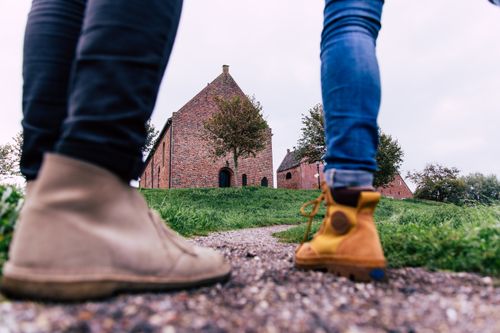
The route is damp and is often referred to as the 'boot trail'. Make sure you wear sturdy boots or fasten your hiking boots extra tightly before starting the route of more than 12 kilometres. After all, a good start is half the battle. The hike starts at Theetuin Blotevoetenhof, located on the Peebos. This beautiful tea garden is part of Staatsbosbeheer Westerkwartier and offers a lovely place to recharge your energy before, during or after your walk. The orchard with robust picnic tables and cheerful colours is worth a visit in itself.


Boundary-defining nature
From the starting point at the Peebos, the route starts and leads you northwards to the border of the province. Here you will come to the Lauwers. This river partially separates the provinces of Friesland and Groningen. The river gave its name to today's Lauwersmeer and the nearby villages of Lauwerzijl and Lauwersoog. It offers a beautiful scenic backdrop that you can watch for hours. If you feel like swapping your walking shoes for something else for a while, the Lauwers is also great for activities such as canoeing. As you walk closer, the soothing sound of the flowing waters of the Lauwers becomes more and more pleasant.
“ ‘You walk from sand, to peat and a bit of clay’ ”
Feel the ground shake
You continue along the route through the area where the peat cutters left their mark. Between the peat pits, you’ll find the historic ‘legakkers’ – once the work areas where peat cutters laid out the peat, soaked in water and cut into pieces, to dry. These ‘legakkers’ now form the basis of the paths you’re walking on. Take a moment to pause at the quaking bog – here you can literally feel the earth quivering beneath your feet. If you jump up and down, the ground springs back, making it feel as though you’re standing on a trampoline. This brings the history of peat extraction in this area vividly to life.
In the ‘petgaten’ – pits created by peat extraction – you can watch the green ‘krabbenscheer’ drift by as you float along. It’s a sight that creates beautiful colours and where nature takes its own course. From May through to July, the white flowers of the crabgrass are once again in full bloom. Every season offers a different view here, and in summer the krabbenscheer welcomes green hawker dragonflies. This rare species flits about during the summer months, so don’t forget to bring your camera and/or binoculars to admire them.


From the Doezumertocht to Peebos
After following the course of the Lauwers, continue east along Melle's Pad, heading for the Doezumertocht. This path is named after Melle Visser. Melle and his wife Lamke used to have a modest farm at the back of the hamlet of Peebos, with a few cows and a small potato crop on a few hectares of land. They had no children and no succession, which meant the land eventually came into the hands of the Forestry Commission. The farmhouse was demolished and all that remains on the land now is Melle's old apple orchard, which runs parallel to the path. This old apple orchard still produces jute pears and Gieser Wildemannen. You will also find 'sedelingen', a tasty apple variety that is rich in vitamins and perfect for making apple sauce.
Trudes Draai
At the end of the Melle’s Pad, you’ll come across the Doezumertocht, where the ‘Trudes Draai’ bridge greets you. The name Trude pays tribute to Geertruida Bosma, the former landowner of this area, back when both the path and the bend already existed. As you walk along the Doezumertocht, you’ll be surrounded by the splendour of Groningen’s lush countryside, the hustle and bustle of Groningen life and the glistening dew on the grassland. But just wait until spring arrives – then this area will once again be a carpet of flowers. As you take in the natural surroundings, you’ll feel as though you’re in a secluded paradise, far away from the hustle and bustle of the surrounding villages.


The splendour of Groningen
On arrival in the hamlet of Peebos, you are welcomed by a historic drawbridge dating from 1930. This bridge exudes historic charm and gives you the feeling of travelling back in time, almost 100 years. Peebos, situated in the municipality of Westerkwartier, is a picturesque area to the west of Doezum, on the border with the province of Friesland. The name Peebos comes from a wood that once stood on this site, possibly owned by a gentleman named Pebe. In the past, this spot was also known as Pebebosch. As you stroll along the path of the same name, you’ll be greeted by the warm smiles of the people of Groningen, surrounded by lush greenery and the cheerful chirping of birds in the wild. Birdwatchers, take note: among others, you can spot the chiffchaff, willow warbler, robin and fazant here.