
Cycling past Groningen’s heritage


“ ‘The reddish-brown “kloostermoppen” bricks, fired from Groningen clay, give the region its character. They’re from here.’ ”
Some call them beacons of silence, tranquillity and contemplation; others praise their robust character; whilst yet others argue that, taken together, they form one great museum. Sometimes we draw comparisons with France or Tuscany to emphasise just how beautiful Groningen’s churches are. But actually, they don’t need that at all. Above all, they are simply themselves. And that is precisely why they are so exceptionally special.
Many of our churches have centuries-old roots. The reddish-brown ‘kloostermoppen’ bricks, fired from Groningen clay, give them their character. They are from here. And the towers? They’re often not even that tall. But perched atop the mounds, they still rise above everything else. Inside, there’s plenty to discover: from centuries-old murals to beautifully masonry vaults. You simply cannot miss Groningen’s churches.
Donatus Church Leermens
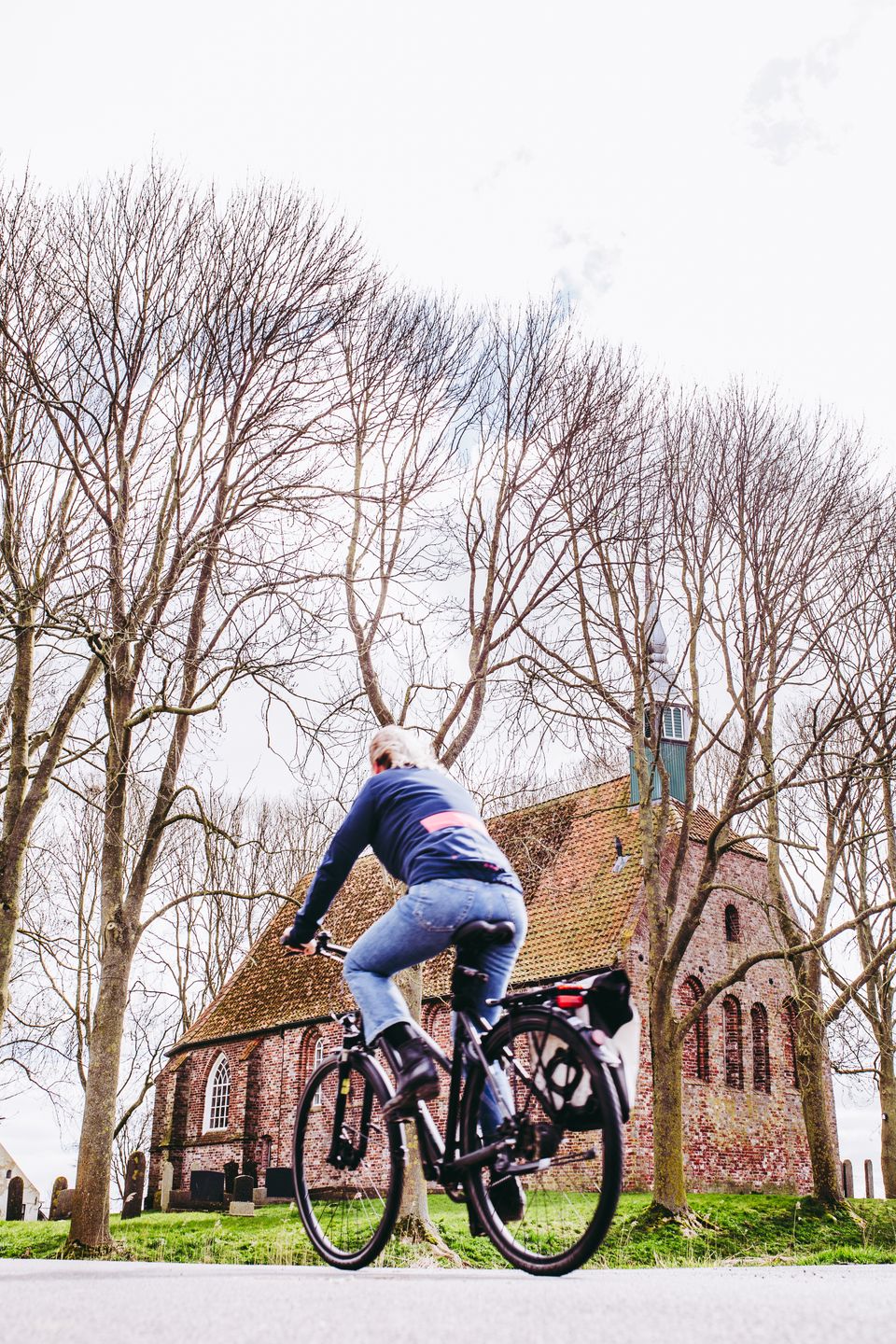
The Donatus Church in Leermens is ancient. It has been built up and remodelled over the centuries. Just look at the side walls made of tuff. This section is the oldest, dating from 1050. In the transept, the tuff stone is mixed with red monastery bricks. In the thirteenth-century chancel, these ‘bricks’ dominate completely. Inside, fifteenth-century paintings adorn the walls and ceiling. Do look up first. Can you spot the symbols of the four Evangelists? And can you see the Lamb of God in the vault? Saint Donatus, Saint Sebastian, Mary and Child, and Saint Ursula look down at you kindly from the walls. And make sure you look closely, because then you’ll see that virgins are sheltering beneath Ursula’s cloak. And who is that crowned figure next to Sebastian? It could well be Emperor Diocletian. The seventeenth-century pulpit is the only surviving piece of original furniture. The rest was lost in a fire in 1957. That sort of thing used to happen quite often. ‘Fire in the church, a red rooster on the roof,’ as they used to say.


Mariakerk Krewerd
This charming little church stands on the wierde at Krewerd. You could spend hours admiring it and almost forget that you can also go inside. There you’ll find the second-oldest organ in the Netherlands. Connoisseurs come from far and wide to hear this organ. It’s still in working order. There are also medieval paintings on display. Just look at the imitation brickwork and the plant motifs on the vaults. The coat of arms is particularly striking. It is full of a bricklayer’s tools: trowel, square, hammer and axe. It couldn’t be otherwise in such a beautifully built church. There is a story behind this late-Romanesque hall church. The widow Tiadeke has a seriously ill son. She lives in a manor house near Krewerd. She vowed to build a church if her son recovered. He did recover, but Tiadeke did not fulfil her vow. When her beloved son later died childless, she had the church built after all, out of a sense of guilt. The Mariakerk is part of ‘The Greatest Museum in the Netherlands’: a collection of the most beautiful Dutch churches. This comes as no surprise once you’ve visited it.


Sebastiaankerk Bierum
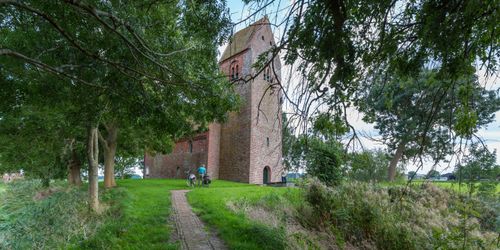
If there’s one church that’s truly impressive, it’s the Sebastiaankerk. And no wonder, with such an enormous buttress holding the tower upright. But there’s more that makes the church unique. Ever heard of a ‘reduced westwork’? It’s actually little more than a church tower built into the church itself. Sounds perfectly normal, but it isn’t – certainly not in this region. The exterior has a Romanesque appearance. The interior, with its barrel vaults and imitation brickwork, is more late Romanesque in character. A church in a transitional style, then. The massive buttress is considerably younger. The fear of subsidence must have been considerable; otherwise, you wouldn’t build such a magnificent buttress. In Bierum, too, you really must pop inside for a moment. Look up and behold Christ, Catherine at the wheel, Sebastian and Mary with the Child. For years, they lay hidden beneath a thick layer of lime.


“ ‘You could look at it for hours and almost forget that you can also go inside.’ ”