



Route 25: Spiekertocht Ter Apel
On this route, you’ll walk past Ter Apel Monastery, the Kloosterspieker and through the Kloosterbos. This route is 6.5 kilometres long.
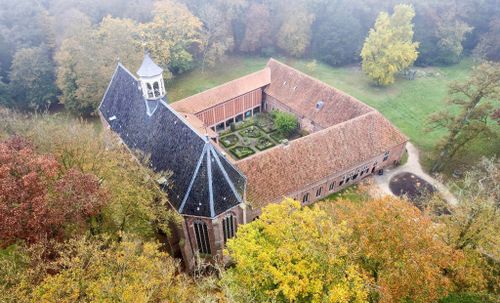
Monastery Ter Apel, a national monument, is a former Kruisheren monastery dating from the 15th century. It is the last monastery founded in Groningen, but the only one of the 34 that the province counted in the Middle Ages that is still recognisably preserved as a monastery. The convent building is used as a museum of monastic and church history and religious art under the name Museum Klooster Ter Apel. The convent's former lay church serves as a reformed church. This Bosch church forms the south wing of the monastery
The Kloosterspieker is a replica of a historic storehouse dating from …
Monastery Ter Apel, a national monument, is a former Kruisheren monastery dating from the 15th century. It is the last monastery founded in Groningen, but the only one of the 34 that the province counted in the Middle Ages that is still recognisably preserved as a monastery. The convent building is used as a museum of monastic and church history and religious art under the name Museum Klooster Ter Apel. The convent's former lay church serves as a reformed church. This Bosch church forms the south wing of the monastery
The Kloosterspieker is a replica of a historic storehouse dating from 1650, built on original boulders and finished with clay and thatch. Originally, the storehouse served as schaapskooi on the monastery enclave. The name ‘spieker’ is derived from the word ‘spica’, which is the Latin word for an ear of corn. ‘Spicarium’ is Latin for a storehouse for corn, a store shed or a granary.
At the Spieker, you can look around and view the (digital) presentation about Ter Apel and Westerwolde with no obligation. For further information, see https://www.kloosterterapel.nl
The Kloosterbos was designed and laid out in the 19th century as an English landscape park. This was commissioned by the city of Groningen, which owned the former Crosier monastery and the surrounding land, including numerous farms. The city council regularly sent councillors to Ter Apel to inspect these properties. The Hotel Boschhuis was the establishment where these councillors stayed. The park became the place where they could relax whilst out walking. It had easily navigable paths, a few ponds, a few small bridges, and so, in many places, a good view of the monastery. It was a park that exuded romance. The City of Groningen retained its properties well into the post-war period, but eventually transferred the walking forest to Staatsbosbeheer. In the period that followed, the forest lost some of its character. It became somewhat wilder, rougher and darker, and the sightlines to the monastery faded or disappeared. To make the monastery and its immediate surroundings – the Klooster enclave – more attractive to visitors, SBB, at the request of the board of Museum Klooster, restored the sightlines in the monastery woods in 2021, meaning that the woodland pond can once again be seen from the monastery and vice versa. Trees have also been removed around the pond and replaced with grass and plants, such as spring flowers, bluebells and winter aconites.
Any comments on the route? Let us know via the contact form
This is a route of the Walking in Westerwolde Foundation. Sponsors of this route are Camping Moekesgat and SportPlaza Ter Apel
Camping Moekesgat, Heembadweg 17, 9561 CS Ter Apel, www.moekesgat.nl, info@moekesgat.nl, tel +31 6 10889217
SportPlaza, Viaductstraat 59, 9561 AC Ter Apel, www.sportplazaterapel.nl, info@sportplaza.nl, tel. 0599 580 802
Here’s what you’ll see

Museum Klooster Ter Apel
Museum Klooster Ter ApelBoslaan 3-5
9561 LH Ter Apel
Features
Walking
- Dogs must be kept on a lead Yes
Tour/Route
-
Comment starting point:
The route starts from the car park at camping Moekesgat.
Heembadweg 17
9561 CS Ter Apel
https://goo.gl/maps/22N2KLontrpKtjW67 - Explanatory marking: Yellow and white stickers printed WIW 25